

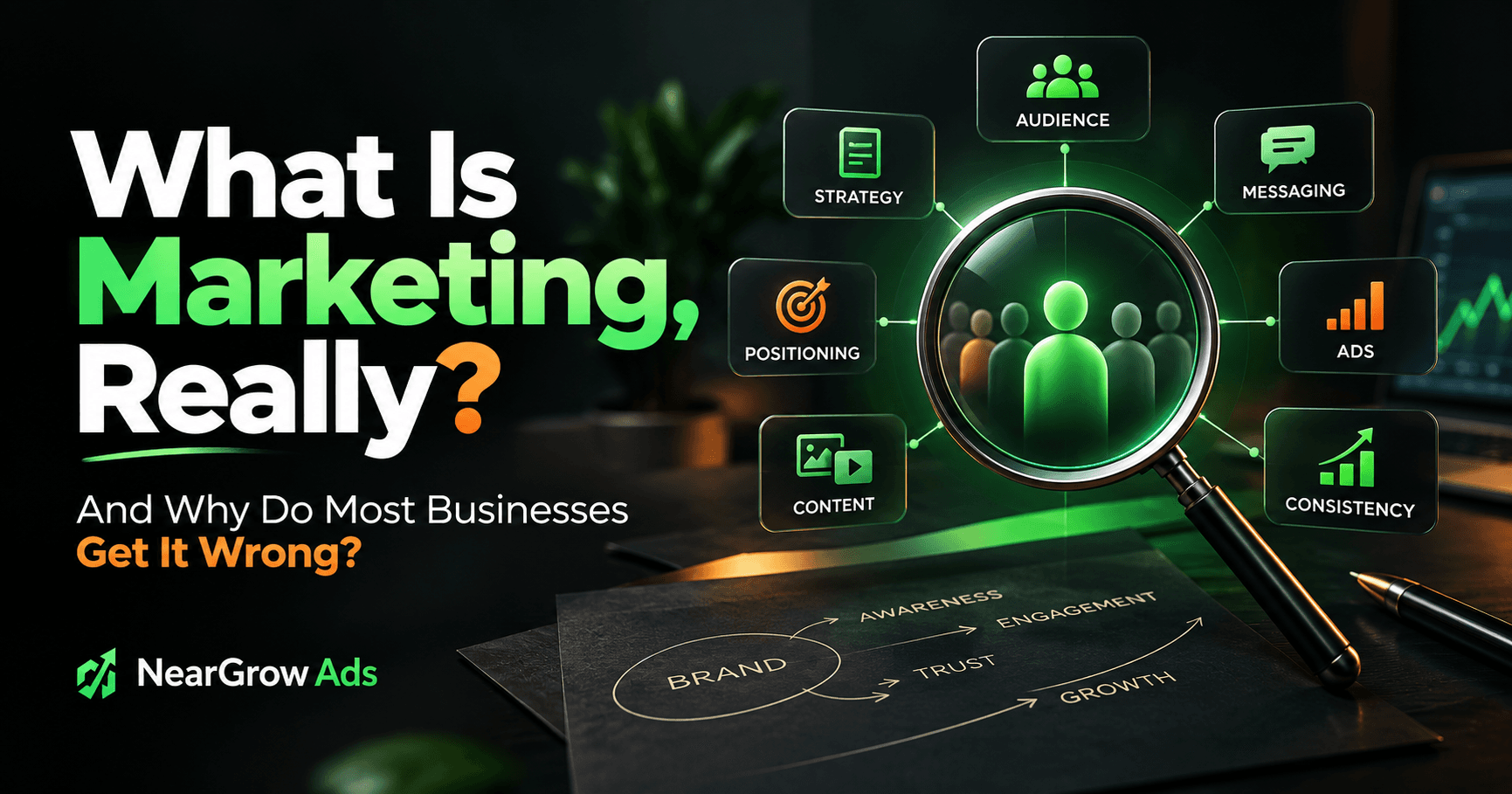
What Is Marketing, Really And Why Do Most Businesses Get It Wrong?
Ask ten people what marketing means, and you’ll probably get ten different answers.
Some will say it’s advertising. Some will say it’s social media posts. Others might say it’s simply convincing people to buy something.None of these answers are completely wrong, but none of them show the full picture.
Marketing, at its core, is about understanding what people need and making sure the right people know that you can meet that need.Advertising, social media posts, branding, campaigns and other promotional activities are simply methods used to achieve that goal.The problem is that many businesses jump straight into these methods without first understanding their audience.
Marketing Isn’t Just Advertising
One of the biggest misconceptions about marketing is that marketing and advertising are the same thing.
Advertising is only one part of marketing.
Marketing covers a much wider range of activities, including:
- Understanding your audience : Who are they? What problems do they have? What do they actually care about?
- Positioning : What makes your product or service different from other options in the market?
- Pricing : Pricing is not only a financial decision; it also affects how customers perceive your brand.
- Communication : Advertising, content, email, word of mouth and every other method that carries your message.
- Customer experience : How customers feel after purchasing from you affects whether they return or recommend your business.
A business that focuses only on advertising while ignoring these areas may simply be shouting louder without communicating anything more useful.
Why Do Most Marketing Efforts Fail?
Businesses sometimes spend money on advertisements or post consistently on social media but still don’t see the results they expected.This doesn’t necessarily mean marketing doesn’t work.There are usually some basic issues behind the problem.
1. No Clear Understanding of the Customer
Many businesses try to market to “everyone.”But when your message tries to speak to everyone, it often connects properly with no one.For example, a 25-year-old freelancer and a 45-year-old business owner may have completely different needs, priorities, language preferences and platforms.Understanding exactly who you want to reach should come before creating the campaign.
2. Copying Competitors
Looking at competitors can be useful, but copying their strategy without understanding why it worked can waste both time and money. What works for another company may depend on its audience, positioning, pricing, reputation or business model. Your marketing strategy needs to make sense for your own market and customers.
3. Inconsistent Messaging
Imagine your website communicates one message, your Instagram says something different and your salesperson explains the business in another way. Customers notice these inconsistencies. When the brand story changes across platforms, trust can quickly decrease. Your website, social media, packaging and customer conversations should all feel like they belong to the same brand.
4. Treating Marketing as a One-Time Activity
One advertisement or a few social media posts usually won’t build a strong brand. Marketing works more like a habit than a one-time activity. Results often develop through consistent effort rather than appearing after one major campaign. Common Marketing Mistakes Businesses Make Several marketing mistakes appear repeatedly across different industries.
Skipping Research
Businesses sometimes launch a product or campaign based on assumptions rather than understanding what customers actually need.
Trying to Be Everywhere
Trying to remain active on five different platforms can lead to average performance everywhere. It can be more effective to choose fewer channels and execute them properly.
Ignoring Existing Customers
Businesses often spend most of their budget acquiring new customers while forgetting the people who already know and trust the brand.
Having No Clear Goal
Every campaign needs a clear objective.
1) Are you trying to generate sales?
2) Build awareness?
3) Increase enquiries?
4) Generate sign-ups?
Without a clear goal, it becomes difficult to judge whether your marketing actually worked.
Expecting Immediate Results
Consistency matters. Giving up too quickly can prevent businesses from seeing the results of the work they have already started.
Not Tracking Performance
Businesses should understand which marketing activities are creating results. Without tracking performance, the same mistakes can be repeated again and again. Most of these problems don’t happen because businesses aren’t putting in enough effort. They happen because businesses move too quickly without having a clear plan.
What Actually Makes Marketing Work?
There may not be one secret marketing formula, but some basic principles consistently improve the chances of success.
1. Know Your Audience First
Understand your audience before writing copy, creating advertisements or choosing platforms. This can save both time and money.
2. Choose Fewer Channels and Use Them Properly
Being excellent on one relevant platform can be more valuable than being average across five platforms. Choose channels based on where your audience actually spends its time.
3. Keep Your Message Consistent
Your website, social media, packaging and conversations should communicate a consistent brand message. Customers should recognize the same brand regardless of where they interact with you.
4. Give Marketing Time
Marketing results usually build gradually. Strong brands are rarely created overnight.
5. Review What’s Working
Regularly review your marketing performance. Small and consistent improvements can be more effective than completely changing your strategy every few months.
Marketing in Simple Words
So, what is marketing?
Marketing isn’t about being the loudest business in the room. It’s about clearly understanding who you’re speaking to and making sure your message reaches those people in a way that makes sense to them. Many marketing mistakes don’t come from a lack of creativity. They happen when businesses rush toward results while skipping the fundamentals. If there’s one thing worth remembering, it’s this: Understand your audience first, and the rest of marketing becomes much easier.
🚀 Get Your Free Google Maps Visibility Check
Want to know how your business appears on Google and where you can improve?
Contact NearGrow Ads today for a free Google Maps visibility check.
📞 +91-9289810149
🌐 neargrowads.com
📧 info@neargrowads.com
Grow Local. Grow Smart. Grow With NearGrow Ads